Pages

Showing posts with label Family Violence. Show all posts

Saturday, June 13, 2015

Domestic Violence Survival: You Can Do It!

Surviving Domestic Violence Domestic violence and domestic abuse are serious issues that affect both men and women. They often go hand in hand, but just because you are not being physically attacked, doesn’t mean you aren’t being abused. It is important to know the signs and recognize when they are present in your life. Some of these signs include… Jealousy over who you talk to. Embarrassing or putting you down in front of others. Finding faults, and correcting things you said or did after a social event. Making you feel worthless / useless / devalued Threatening you or your loved ones / pets. Wants to be involved with and control everything you do. Checks in often and regularly to see what you are doing, where you are, and who is with you. Always wants you to do things with their friends and family. Is not interested in spending time with your friends, family, or activities, and objects to you being involved. Keeps money from you and doesn't put you on credit card accounts, checking and/or savings accounts. Slams things, throws things, or breaks things when upset. Punishes you, by abusing your children, or pets. Makes all the decisions in your relationship. Doesn't let you further your education, or work. Requires you to work excessively while all the money goes to them. Blames you for their mistakes. Denies, or controls your access to medicine, medical care, or medical devices. Pushes, slaps, restrains, kicks, punches, or in any other way physically hurts you. Threatens to turn you into immigration for deportation. Expects/demands sex, sexual acts you aren't comfortable with, or sexually assaults you. Regardless of how long the relationship has been going on, the sooner you get out the better. The longer you stay, the harder / more dangerous it becomes to get out. The abusive partner will be more invested as time passes, and more determined to keep you from getting away. Verbal Abuse Verbal Abuse is often used before the physical abuse starts or in conjunction with it. The abusive partner uses this to tear you down and make you easier to control / manipulate. The more they can get you to feel worthless, the more power they ultimately have over you. Do these examples sound like they would come from someone speaking out of love? “Everything you say is stupid, nobody wants to hear it, you should just keep your mouth shut.” “If you had done it right, then I wouldn’t have to be mad at you.” “Why are you dressing like that, you look like a whore, do you want other people to think that’s what you are?” “You can’t do anything right, you’re lucky I put up with you, nobody else ever will.” Don’t let this bring you down, recognize this for exactly what it is, abuse. Someone trying to make you doubt yourself. Remember that you have value and worth, and that you don’t deserve to be treated that way.
Breaking Free Now that you know the signs and if you have decided to move on, here are a few things to help with the process. SAFETY IS NUMBER ONE!!!!!! Your Safety and the safety of your children are number one and not negotiable. Make a safety plan, know when the best time to leave will be Have somewhere you can go that will be safe, while you put your life back together Learn their triggers and how to avoid them, if you have children make sure they will be safe as well Leave any nonessential belongings. You can buy a new wardrobe, you can’t buy another life Don’t Respond with violence, unless you have to defend your life. It will immediately escalate things. Let them know where you are going Leave them anyway to find you. Pick up a pre-paid cell phone. If your car has a tracking device, disable it. Think of anything else that can be used to find you, and remove it from your life. These are only a few of the things you can do when leaving an abusive or dangerous relationship. It’s a long hard road, but you don’t have to be a victim. You can take control of your life and make sure you are safe. No one deserves to abused or live in fear for themselves and their children or loved ones. For additional information, resources, or help 24 hours a day, 365 days a year, please call the National Domestic Violence Hotline at 1-800-799-7233 or TDD at 1-800-787-3224, or visit their website at www.thehotline.org.


Sunday, November 23, 2014

Tips For Surviving The Holidays: Recognizing & Overcoming The Holiday Blues

It happens every year. Shortly after Halloween, the Holiday season begins. It starts with the retail ads, picks up speed in the grocery stores, and often consumes the work place and community, then before you know it the tidal wave of “good cheer” has taken over everyday life. Except, many people don’t feel very cheerful. In fact, at times, many people find themselves simultaneously dreading and resenting the Holidays. Indeed, some may even find themselves identifying with Ebeneezer Scrooge, in that they are inexplicably feeling angry, bitter, sad, resentful, overwhelmed, lonely, and disconnected. However, if you or someone you love believe have identified many, if not all, of the symptoms of “Scrooge-itis” this does not mean you secretly dislike children, nor that you will suddenly become miserly, greedy, or mean. What these symptoms may mean is that you or a loved one may be struggling with unresolved Grief and Loss, Traumatic Grief, Trauma, Abandonment issues, or concerns otherwise deemed “The Holiday Blues.” The good news is you, or your loved one, is not ALONE! Thousands of people feel the exact same way each and every year. The importance of recognizing the signs and symptoms associated with “The Holiday Blues” and seeking professional help is the key to successfully coping with the holiday season. If you, or a loved one, are experiencing several or more of the following symptoms seek immediate assistance from a mental health professional in your area, or call the National Crisis Hotline 24 hours a day at 1-800-273-8255 www.suicidepreventionlifeline.org: 1) Sadness 2) Tearfulness 3) Hopelessness 4) Isolating 5) Unexplained loss of Interest in previously enjoyed hobbies or activities 6) Unexplained loss of appetite 7) Unexplained increase in appetite 8) Unexplained anger/irritability 9) Disrupted Sleep 10) Inability to focus 11) Increased use of alcohol 12) Suicidal Ideation 13) Homicidal Ideation 14) Poor hygiene/lack of desire to bath/brush teeth 15) Increased absences at work or school For more information, or referrals, regarding coping with the Holiday Blues help is just a phone call away. Call 211, 1-800-854-7771 or visit www.healthycity.org or www.namila.org/crisis-hotlines-hospitals For life threatening emergencies or immediate assistance call 911. Remember, you are not alone! Happy Holidays from All of Us at North Valley Anger Management Consultants! For more information about our anger, stress, and domestic violence programs call 1-888-992-6479 or visit www.nvamc.com.

Sunday, August 17, 2014

Domestic Violence is Aggravated Assault: Only You Can Stop The Cycle of Violence!

DOMESTIC VIOLENCE IS AGGRAVATED ASSAULT!
Don't Live in Fear of Domestic Violence ! If you, or someone you love, is living with domestic violence help is available 24 hours a day. Take the first step and make a phone call; you may be saving a life. For further information, please call the following numbers 24 hours a day, 7 days a week, 365 days a year. Domestic Violence Hotline 800-978-3600 National Domestic Violence Hotline 800-799-SAFE (7233) TDD 800-787-3224 Domestic violence is more than just a "family problem"; it is a crime. The Los Angeles Police Department (LAPD) recognizes that domestic violence is a major problem in Los Angeles County and throughout the United States. Each year, more than two million women are victims of domestic violence, and one million children are physically abused. In California, it is a crime for any person to threaten, beat, sexually assault or otherwise harm another person, even if they are married. Battering is not exclusively a crime against women, but they are the majority affected. One of every two families in the United States is involved in domestic violence at some time. Domestic violence is a repetitive pattern in people's lives. Victims or witnesses of domestic violence in childhood are mostly likely to repeat such acts as adults. The current incidence of domestic violence cannot be tolerated. Too many women are beaten. Too many children are abused. Too many homes are battlegrounds. There is a way out! Victims do not need to submit and lead a life of tension between calm and storm. If you are a victim of domestic violence, now is the time to start thinking about protecting yourself. The fact that you are seeking assistance is a very good sign. It means you are seriously considering your situation. Calling the police, telling a friend, or contacting a shelter is the first step. Please don't wait until it is too late. Many studies show that an uninterrupted cycle of violence only worsens over time. Hotlines and shelters are there to be used and counseling is available. It's as close as a phone call and it's free. Let us help you. Stop the violence and stay safe! If you would like further information about domestic violence or other mental health services, please call 1-888-992-6479. Your consultation is free and confidential.

Saturday, February 9, 2013

Four Simple Tips for Managing Anger


Four Simple Tips for Managing Anger


The four, simple, proven secrets to anger management are:

• Self-awareness

• Self-control

• Social -awareness

• Relationship-management

According to industry leaders, these are the four domains of emotional intelligence, and as such is the most successful route to anger management that is currently available. Strategies to master the above principles of living can best be accomplished in individual, or group classes, with curricula designed exclusively for this purpose including 8 Minute Meditation: Quiet Your Mind. Change Your Life. by Davich, Vic (Google Affiliate Ad).

For assistance managing emotional re-activity  anger, or other aggression related concerns, please visit our website www.nvamc.com, or call us at 1888-992-6479.

North Valley Anger Management Consultants
www.nvamc.com 
DYNAMIC MEDITATION DVD (DVD) (Google Affiliate Ad)
www.thecaamp.com
[CD] Mantra Meditation for Physical Health By Ashley-Farrand, Thomas (Google Affiliate Ad)
www.theccbi.com
Natural Fitness Eco-Smart Yoga Mat (Google Affiliate Ad)
MEDITATION FOR BEGINNERS (DVD) (Google Affiliate Ad)

Monday, January 28, 2013

Edward Furlong & Milton Bradley Demonstrate The Need For Anger Management

Edward Furlong & Milton Bradley Demonstrate the Need for Anger Management


Anger is one of the most misunderstood and overused of human emotions. Anger is not a planned action – it’s a reaction to an inner emotion. Anger is energy. It serves a purpose by giving people the drive and determination to cope with the often difficult situations we find ourselves in. Anger helps discharge tension. If handled well, anger can help resolve conflict and improve relationships with others. Anger is an easy emotion to show; everyone gets angry.

However, what everyone doesn’t do is explode with public displays of person-directed anger in their relationships, custody disputes, or sporting events. While anger is a normal human emotion, the displays of verbal aggression and anger recently demonstrated by Furlong represents unhealthy anger, which destroys interpersonal relationships as well as the reputation of the perpetrator.

There are six situations in which anger is unacceptable in a civil society:
1). When it is too intense.

2). When it occurs too frequently.

3). When it lasts too long.

4). When it leads to person-directed aggression or violence.

5). When it destroys interpersonal relationships.

6). When it has health implications.

For help dealing with unhealthy levels of anger or rage, please visit our website or call us for a free  consultation.

North Valley Anger Management Consultants

www.nvamc.com

1-888-992-6479

Monday, January 14, 2013

Causes & Cures For Anger

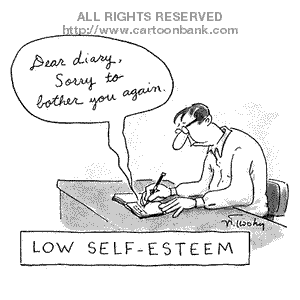
Anger is a secondary emotion that people unconsciously use to protect or deflect a wide variety of uncomfortable feelings away from themselves and possibly onto other people. Many times anger stems from low self-esteem, or other feelings of inadequacy. What then is self-esteem and why is it important? How can we recognize it and what can we do to increase it? While much of a person’s self-esteem is developed throughout their childhood and is rooted in their family of origin, we can always make the conscious effort to alter our behaviors and learn to increase our sense of purpose, accomplishment, and acceptance later in life. This is typically a slow process and it isn’t always easy.

Here are some ways to catch these negative patterns as they happen, and to begin changing them.

•Get sober. Get help through 12-step groups to stop self-destructive behaviors. Addictions make learning harder and can bring down your mood.
 •Practice self-care. Make new positive lifestyle choices.
 •Identify triggers to low self-esteem. Don’t personalize negative or stressful events (e.g., criticism). If you do a self-defeating action usually follows.
 •Stop and take notice. Pay attention to the familiarity of the impulse. We tend to overreact in the same way to the same things over and over again.
•Acknowledge reaction. Take note of how you are reacting. Then actively choose to change it rather than just passively noticing it.
 • Choose response. Hold in self-defeating impulses and instead act in a positive, self, caring and functional way.
 ◦Experience feelings. “Feel” feelings in your body and identify your needs. When we do not respect our feelings, we are left to rely on what others want and believe.
 ◦Detachment. End all abuse; say “no” to misrepresentations and assumptions. By maintaining personal boundaries, we discourage abuse by others and assert our separateness.
◦Assertion. Voice what you see, feel, and want by making “I” statements. By expressing our thoughts, feelings, and desires in a direct and honest manner, we show that we are in charge of our lives.
◦Receptivity. End self-absorption; listen to others’ words and meanings to restate them. In this way, we act with awareness of our contribution to events as well as empathize with the needs of others.
For more information about coping with anger through increasing self esteem, please visit our website at www.nvamc.com, or call us at 1-888-992-6479. Remember, "we are not responsible for being down, but we are responsible for getting up" (Jessie Jackson).


Tuesday, December 25, 2012

Anger: A Normal Human Emotion

Per George Anderson, LCSW, anger is a normal human emotion. Consequently, our anger is one of the  first indications that we have sustained an emotional injury that causes us to feel, hurt, offended, attacked, frightened or sad. This is not an uncommon response to more vulnerable feelings. In fact, anger even has a positive side to it. Some examples of the positive uses of anger include Martin Luther King and his struggles to end discrimination in America, Nelson Mandela (www.nelsonmandela.org) whose struggle against South Africa mobilized most of the world against his adversaries, and Rosa Parks whose anger was the source of the Montgomery Bus Boycott. Another example of a positive outcome in sighted by anger is that of Mahatma Gandhi, whose anger and resulting passive resistance stance against England occurred in direct response to Britain’s domination of India.


However, anger also has very negative connotations, and is often associated with unhealthy and abusive aspects of the human condition. Anger maybe considered a problem when it is too intense, occurs too frequently, is harmful to self or others, lasts too long or leads to aggression. Unfortunately, as the economy continues to struggle and the cost of living remains astronomical, there has been an increase in unhealthy anger and aggression worldwide. This increase is visible across all sectors of our society including government, politics, professional sports, business, education, and medicine.

Therefore, emotional intelligence may no longer be effectively managed at the individual or family level, but may require voluntary and mandated training in stress management, anger management, communication and impulse control.

For more information about managing stressful emotions, please visit our website at www.nvamc.com, or call us at 1-888-992-6479.

Sunday, December 2, 2012

Are Anger & Abuse Pre-requisest for Love?

One of the most powerful concepts to implement in any relationship is UNCONDITIONAL LOVE. So the question truly becomes how you define unconditional love, and what are you willing to do to mend the hurt and pain you are currently feeling without passing blame onto the other person. Each person must communicate their love in a calm, clear, and direct, fashion in order to demonstrate respect to their partner. Our emotions have an amazing ability to unite people; however, left unchecked, they possess the same propensity to divide us.

Daniel Goldman(http://www.mbni.med.umich.edu/mbni/faculty/goldman/goldman.html) defines EMPATHY, which is a significant factor involved in unconditional love, in three ways. The first is cognitive empathy, meaning that we can understand how the other person thinks; we see his or her point of view. He states "this makes for good debaters, sales people and negotiators. On the other hand, people who have strengths in cognitive empathy alone can lack compassion – “they get how you see it, but don't care about you". The second is emotional empathy, which refers to someone who feels within herself the emotions of the person he or she is with. Goldman states "this creates a sense of rapport, and most probably entails the brain's mirror neuron system, which activates our own which in turn circuits the emotions, movements and intentions we see in the other person". This type of empathy creates opportunities of compassion and love. Consequently, this is where the third type of empathy, empathic concern, comes into play. Empathic concern "means we not only understand how a person sees and feels in the moment, but also prompts us want to help them if we sense the need". This unlocks the door to true empathy and unconditional love.

As you read this article, can you think of an experience where someone demonstrated Unconditional Love? What area of empathy do you most find yourself demonstrating (cognitive empathy, emotional empathy, or empathic concern)? Do you believe you have to hurt or be hurt to receive love?


If you are in a relationship in which you are hurting the ones you love physically, emotionally, or mentally we can help. For more information and a free consultation, please call 1-888-992-6479 or visit our website at www.nvamc.com today. Help is just a phone call away!

For additional resources, including assistance with a safety plan, please call the national domestic violence hotline at 1-800-787-3224 or visit their website at http://www.thehotline.org/ today.

Saturday, November 24, 2012

Safely Coping With Holiday Anger & Stress


One may think the Holiday Season is everybodys  favorite time of year. The weather is cooling. The leaves are falling; the food is getting richer and more decadant. It’s the time of smiling faces, warm cozy fires, hearts full of joy, and families filled with love and togetherness right?

As pretty a picture as the media would try to sell us, we all know the truth. The Holidays are full of family stress, anger, conflict, and pressure. In fact, some of the the following stress filled messages may be running through your mind right now. What will we make for dinner? Who is coming over? What is the budget looking like for presents this year? How do I stop myself from getting angry at the in-laws? Where will my family stay? Is there enough space in our house? Will the kids actually let me sleep today? Do I really want to have to talk to my brother, mother in law, cousin, other family members I don't like ?


With all these stresses and pressures a short temper, anger, and cranky snappy responses are bound to arise. All it takes is the smallest thing to set us off during these times. Sometimes maladaptive coping, such as over indulgence in food and drink can seem like the only way to get through the season.

Coping with the season in a positive and safe way is not easy, but it can be done.
Often, it is the the little things that help the most.  Just remember to breathe, the holidays don’t last forever. Try to keep in mind that even with all the build up, expectations and disappointment that often come with the season, ultimately they are just days, and you can get through them just like you do every other day that has come, or is yet to come. Just be aware of your mood and tone of voice, your body language, and that other peoples behavior is not personal. Another thing to keep in mind is that alcohol only adds to the problem, and can be down right dangerous. Keeping the holiday cheer in check will help keep the anger and stress in check too. It helps when you realize that everyone else is just as stressed as you are. You are not alone; just smile, relax and try to enjoy what you can. Remember, you are the only one who can keep yourself safe, sober, and under control.

For information and assistance coping with holiday stress, please visit our website at www.nvamc.com  or call us toll free at 1-888-992-6479 today.

Happy Holidays from North Valley Anger Management Consultants!

Sunday, November 18, 2012

How to Survive The Holidays Anger Free

The Holidays can be challenging for many people, most especially during these difficult economic times. Whether finances or family are giving you the Holiday Blues, following the road map below will definitly help you to successfully negotiate the emotional tidal wave associated with the season without loosing control, exploding in anger, or over indulging.

The key surviving the Holidays without explosive anger is resiliency: Having resilency means developing a set of tools we can use to cope with the various emotional challenges and triggers the Holidays may bring. Resiliency is a learned behavior that anyone may learn and incorporate at any point in their life.

Defining Resilience:
The word "resiliencies" is used to describe clusters of stengths that are mobilized in the
struggle with hardship. The vocabulary of strengths includes seven resiliencies which are as
follows:
Insight -
asking tough questions and giving honest answers.
Independence -
life.
distancing emotionally and physically from the sources of trouble in one's
Relationships -
making fulfilling connections to other people. -
Initiative -
taking charge of problems.
Creativity -
using imagination and expressing oneself in art forms.
Humor -
finding the comic in the tragic.
Morality -
acting on the basis of an informed conscience.
Diagramming the Seven Resiliencies:
The Wolins have represented the resiliencies pictorially on a diagram they call the
resiliency mandala. A symbolic circle that stands for peace and order in the self, the mandala

was identified by Carl Jung as a universal symbol.


For more information about coping with anger, or a free consultation, please call 1-888-992-6479 or visit our website at www.nvamc.com today.
Happy Holidays!
North Valley Anger Management Consultants

Wednesday, August 1, 2012

Overcoming Anger Addiction

Anger is an emotion we are all very familiar with. Despite being a universal emotion of the human condition, anger is generally viewed in a negative way and most people love to hate it. However, anger, over time, can become an addictive rollercoaster trapping you in toxic thoughts, patterns and behaviors. In short, people can become addicted to anger, or rather the emotional response know as anger.

So what causes people to become additcted to anger? Well, anger triggers the primal, subconscious, part of your brain designed for survival and fight or flight responses. When it is triggered, waves of chemicals ,such as dopamine and adrenaline, flood your system giving you a quick false sense of feeling good. Your body then subconsciously begins to settle into this comfortable and familiar routine of getting angry to protect itself and gain that quick feel good.
So just what can we do about all this? There are many things we can do to solve this problem. The first and most important thing we can do is learn to recognize just when we are about to go into this state of toxic, feel good anger, and respond to it with ways to move away from this course of thought. Remember that by design your subconscious is not capable of rational thinking, rather it relies on messages and beliefs that were absorbed during  formative childhood years. This means that it is up to you to consciously recognize this, and decide to change it.

 Another thing we can do is to form other patterns of behavior that give us a feel good response, without being harmful to our mental and physical well being.This is called building resiliency through the creation postive personal habits. The important thing to remember is that no one is powerless over their emotions, and we all have the capacity for positive growth and change; we just have to learn to accept it. Truly knowing yourself is scary, and can be difficult, but with dedication and patience anyone can do it.   

For information, or a free consultation, please call us at 1-888-992-6479, or visit our website at www.nvamc.com.

Wednesday, June 20, 2012

The Price of Domestic Violence

Domestic violence (DV) is more than anger. It is more than abuse. It is not about gaining pleasure from inflicting pain. What it is about is the power and control of one person over another brought about through a combination of intimidation, physical, mental, and emotional cruelty. What domestic violence is is a living nightmare for the victims trapped within it's clutches. It is in every city, on every block. It is unbias and nondiscriminatory. It effects rich and poor alike and has no regard for social or political status, and its effects are long term and hereditary.

 Witnessing domestic violence is in and of itself a form of child abuse and neglect. Unfortunately, the trickle down effect of  DV does not end there. Domestic violence is often discussed clinically, in terms referring to the physical, psychological, behavioral, and societal cost,yet it is the human cost that needs to be profiled. The physical effect of domestic violence alone, such as damage to a child's growing brain, can cause developmental and learning impairment including cognitive delays and behavioral difficulties. However, the physical effects of exposure to abuse is only the tip of the iceberg.

As the children from a home with domestic violence grow up, they are predisposed to become abusers themselves. The recurring cycle of violence often begins on the school yard, with the child bullying other children, and ultimately ends with the child becoming an adult who perpetrates domestic violence themselves.
According to the United States goverment, an estimated 905,000 children were victims of exposure to domestic violence, a form of child abuse, both physical and emotinal, and neglect in 2006 (U.S. Department of Health and Human Services, 2008). While physical injuries may or may not be immediately visible, abuse and neglect not only can but will have consequences for the children and families that experience this abuse that will last the course of the victims lifetime, and often for generations to come.

For these families, living in fear and pain is all they know. The emotional and physical cost of domestic violence to children and families is unconscionable. Stopping the cycle of violence is the only way to end the multi-generational pattern of abuse being passed down from parent to child ad infinium amen.

IF YOU ARE A VICTIM OF DOMESTIC VIOLENCE PLEASE CALL YOUR LOCAL SHELTER, YMCA, OR LAW ENFORCEMENT AGENCY IMMEDIATELY. THESE AGENCIES MAY BE REACHED BY DIALING 211, 411, OR 911.

If you are a batterer/perpetrator and have been court ordered to seek help in stopping the abuse, or are self referred, please call 818-606-7531 for more information, or visit our website at www.nvamc.com.

For more information about the effect of abuse on children, stopping the cycle of domestic violence,  resources to help a victim recovering from domestic violence abuse, please visit the following websites:


http://www.cpedv.org/

cadv.org/children.html

http://www.youtube.com/watch?v=xYWxfxMOUO4

Sunday, January 15, 2012

Anger Management for Parents

Today's parents are dealing with more day to day frustration raising their children than ever before. In the majority of homes, parents are not only working, attempting to provide after school activities via sports programs, scouting, etc, but are also trying to maintain relationships with significant others, family, friends, religious affiliations, etc. Many of these homes are single parent households, which adds even more stress to the equation. Factor in those parents who are also trying to go to school in addition to everything else, in an attempt to improve there ability to earn a livable wage, and the stress multiplies expotentialy. Throw a defiant teen, or angry young one acting out due to divorce or other concerns, into the mix and you have a pressure cooker ready to blow at any moment. So how can mom&dad; diffuse their frustration and cope with the stress of parenting children in the twenty-first century? Are we really talking about anger management for parents? The answer is yes. In fact, anger management techniques are appropriate for everyone, everywhere, in all walks of life and parents are no exception. Mom&dad are people too, and are dealing with even more stress than those without children and as such have even greater need of anger management skills to cope with the demands of modern life. The following anger management techniques are recommended as stress management tools for parents to use to prevent nuclear implosion : 
1) Lean to identify the physical signs of rising anger such as tightening of the stomach, neck, shoulders, clenched fists, gritting of teeth etc.

2) When the above signs are identified, count backwards to refocus your thoughts.

3) Give yourself a time out and walk and disengage from the source of stress while counting backwards.

4) Utilize relaxation techniques such as slow deep breathing, guided imagery, isometric excersises, stretching.

5) Give yourself fifteen minutes of unscheduled time a day just for you.
At North Valley Anger Management Consultants, we understand the unrelenting demands of being a parent in the twent-first century and are available to help. For a additional information, visit our website at www.nvamc.com or call us at 1-888-992-6479.


Sunday, March 20, 2011

Emotional Intelligence & Anger


Emotional Intelligence & Anger

According to Wikipedia, "the earliest roots of emotional intelligence (EQ) can be traced to Darwin's work on the importance of emotional expression for survival and second adaptation. In the 1900s, even though traditional definitions of intelligence emphasized cognitive aspects such as memory and problem-solving, several influential researchers in the intelligence field of study had begun to recognize the importance of the non-cognitive aspects. For instance, as early as 1920, E.L. Thorndike used the term social intelligence to describe the skill of understanding and managing other people.

Similarly, in 1940 David Wechsler described the influence of non-intellective factors on intelligent behavior, and further argued that our models of intelligence would not be complete until we can adequately describe these factors. In 1983, Howard Gardner'sFrames of Mind: The Theory of Multiple Intelligences introduced the idea of multiple intelligences which included both interpersonal intelligence (the capacity to understand the intentions, motivations and desires of other people) and intrapersonal intelligence (the capacity to understand oneself, to appreciate one's feelings, fears and motivations). In Gardner's view, traditional types of intelligence, such as IQ, fail to fully explain cognitive ability. Thus, even though the names given to the concept varied, there was a common belief that traditional definitions of intelligence are lacking in ability to fully explain performance outcomes."

Anger is a primitive emotion that all human beings experience. However, it is important to note that anger can also have a very disruptive effect on one's emotional intelligence (EQ). One technique that may be of  assistance with re-empowering the intelligence aspect of one's psyche is anger management. Through the use of an evidenced based anger management program, students are taught to utilize thought (intelligence) to circumvent feelings (emotion) from negatively influencing actions. Although anger is hard wired into the reptillian brain, it does not have to over ride emotional intelligence (EQ). To reclaim control and increase your EQ, consider employing thought stopping, relaxation techniques, as well as increasing verbal expression all of which have become components of successful anger management programs.

For more information about anger management and it's ability to assit individuals with increasing their emotional intelligence visit www.nvamc.com or call 888-892-6479 today.

Monday, January 31, 2011

Road Rage Experiences?


If you live in any metropolitan or suburban area in the county, with congested freeways I am sure you have had an experience with road rage.
What is that brings about Road Rage?  The emotions of stress, frustration, and anger well up and people do risky, even dangerous things, they would not do otherwise.  Here in the Sacramento Area we have busy congested freeways and surface streets that often create such a storm of emotions (that they may not even be aware of) that behind the wheel they change into a different person just to save a little time.  This is one of the more common ways people act out in anger, a study conducted by the Automobile Association in 1995 found that 90% of drivers had experienced road rage incidents, and 60% of drivers admitted to losing their tempers.  In this study they found:
  • Aggressive tailgating (62 percent) was the most common form of “road rage,” followed by headlight flashing (59 percent), obscene gestures (48 percent), deliberately obstructing other vehicles (21 percent) and verbal abuse (16 percent). One percent of drivers claim to have been physically assaulted by other motorists.
What underlies Road Rage or Aggressive driving is pent up stress, frustration, and anger.  Perhaps for one person it was a bad day at work, or for another person an argument with a co-worker.  Our mood and our ability to manage our stress is often at the core of the problem.  For some clients we see this has become a chronic habit because the constant percevied pressures, deadlines, and irritation of their commute.  For many individuals, this is only one of the areas of their life where stress and anger are affecting them.  Often these same clients in our office describe communication problems at work or at home, arguments that seemed to stem from small issues become episodes wherein they lose their cool and say things they later wish they could take back.  I had a client the other day expressing deep frustration at the late night arguments he was having with his wife.  These initial miscommunications seemed to boil into long protracted arguments that continuously left them both tired and exhausted without truly resolving anything.
The good news is that if you or someone you care about is struggling with these issues, something can be done.  Stress and Anger are a part of everyday life, but they can be controlled, managed , and preventive strategies can be used to avoid allowing anger to control your life.  We at North Valley Anger Management Consultants take an evidence-based, skill-building approach to working with clients.  As Certified Anger Management Specialists, we utilize trusted curriculum that is customized to each clients needs based upon a research-based assessment that determines core areas of strength and weakness among domains such as: Stress Management, Empathy, Communication Styles/Skills (like assertion, aggression, and deference), and Emotional Intelligence.  This process yields great results for clients that are ready to make a change in their lives.
If you or someone you love is ready to make a change call us today at 1-888-992-6479 or visit us on the web at www.nvamc.com

Saturday, December 18, 2010

Don't Let The Grinch Get You Down: Coping With Holiday Anger!


With the state of the economy, rise in unemployment, and hyperinflation holiday anger is on the rise.
The following five tips have been found useful to help you and your loved ones deal with holiday stress:
1. Watch carefully the amount of alcohol you consume. Many anger management students confess that excessive drinking definitely contributed to family conflict and aggression.
2.Reduce stress by managing your time carefully and not over-scheduling yourself. Take time for yourself.
3. Adjust your expectations of family members. No, Aunt Irene hasn’t changed since last year. Tell yourself that you only have to see her once a year- you can cope with it.
4. Work on forgiveness skills. Let old resentments go. Holding grudges hurts you more than your relatives.
5. Develop better empathy skills. Try to see the world from the viewpoint of irritating family members and you may be shocked at how your anger dissipates.
For more tips on how to deal with angry feelings or the angry behavior of others, call us at 888-992-6479 or visit our website at www.nvamc.com



Tuesday, December 14, 2010

Even Moms get Angry!

Why do we hurt the ones that are closest to us?  Why do we say things we regret?  I met with a mom again the other day that struggled with anger towards her children and had late night arguments with her spouse.  It is not uncommon that people tend to express their anger towards those they are closest to the most, that they feel the most comfortable with.
If you are ready to stop this cycle of painful behavior in your relationships with your family we are here to help.  We have a variety different options for you.  Most moms we meet with benefit from one-on-one sessions that focus on Emotional Intelligence, Stress Management, Anger Management, and Communication Skills at home.  There is a solution and our team of professionals is here to help you.

Make a Holiday wish come true for you and the ones you love.To schedule a confidential appointment please call our office at (888) 992-6479 or visit our website at http://www.nvamc.com/

The Dr. Phil Show - Angry Moms Width: 425 Height: 350

Sunday, December 5, 2010

Holiday Survival Kit

The Holidays can be a difficult time for many people, most especially during these difficult economic times. Below is a road map to successfully negotiate the emotional tidal wave  associated with the season without loosing control, exploding in anger, or over indulging.

THE KEYS TO RESILIENCY are tools we can use to cope with the various emotional challenges and triggers the Holidays may bring.  Resiliency is a learned behavior that anyone may learn and incorporate at any point in their life.

Warm Regrads,
North Valley Anger Management Consultants


Defining Resilience
The word "resiliencies" is used to describe clusters of stengths that are mobilized in the
struggle with hardship. The vocabulary of strengths includes seven resiliencies which are as
follows:
Insight -
asking tough questions and giving honest answers.
Independence -
life.
distancing emotionally and physically from the sources of trouble in one's
Relationships -
making fulfilling connections to other people. -
Initiative -
taking charge of problems.
Creativity -
using imagination and expressing oneself in art forms.
Humor -
finding the comic in the tragic.
Morality -
acting on the basis of an informed conscience.
Diagramming the Seven Resiliencies
The Wolins have represented the resiliencies pictorially on a diagram they call the
resiliency mandala. A symbolic circle that stands for peace and order in the self, the mandala
was identified by Carl Jung as a universal symbol.