“The sins of the father shall be visited upon the
son” a very powerful and well known biblical
 reference, from the book of Ezekiel,
regarding the raising of one’s family to be righteous. In fact, when we
consider the implications involved in parenting and raising a family, no truer
words have ever been spoken, but not for the reasons one might think. Biblically,
the inference of sinfulness is generally interpreted as impiety, and is avoided
via the father teaching a familial pattern of pious worship.
reference, from the book of Ezekiel,
regarding the raising of one’s family to be righteous. In fact, when we
consider the implications involved in parenting and raising a family, no truer
words have ever been spoken, but not for the reasons one might think. Biblically,
the inference of sinfulness is generally interpreted as impiety, and is avoided
via the father teaching a familial pattern of pious worship.
So how does this infamous quote from scripture apply to the modern family and why is it relevant? This profound and insightful verse is speaking to the multi-generational system of learned behavior that exists within a family. The question then becomes, how do people learn? Cultural Anthropology suggests the most powerful form of learning is observational. Therefore, we learn what we live, which is to say that which we see every day determines how we behave with one another other.

 Fortunately, through a combination of increased
awareness and psycho-education in the areas of parenting, anger management,
stress management and domestic violence programs it is more than possible to stop
the multi-generational cycle of child abuse. However, the first step is
increasing awareness. For purposes of clarity, please note that in the state of
California the only legal form of physical punishment a parent may use to
correct a transgression is for the parent to spank their child one time with an
open hand upon the child’s posterior. In addition, California further defines
child abuse as any form of physical contact that leaves a mark including
spanking should the spanking leave any marks upon the child’s posterior. If
you, or someone you love, is a victim of child abuse as stated above, intimate
partner violence, or other form of emotional or mental abuse including neglect
help is available 24-7 by calling 211, 1-800-540-4000, or 911. Remember, only
through awareness and advocacy will change occur. Being a child doesn’t have to
hurt!
Fortunately, through a combination of increased
awareness and psycho-education in the areas of parenting, anger management,
stress management and domestic violence programs it is more than possible to stop
the multi-generational cycle of child abuse. However, the first step is
increasing awareness. For purposes of clarity, please note that in the state of
California the only legal form of physical punishment a parent may use to
correct a transgression is for the parent to spank their child one time with an
open hand upon the child’s posterior. In addition, California further defines
child abuse as any form of physical contact that leaves a mark including
spanking should the spanking leave any marks upon the child’s posterior. If
you, or someone you love, is a victim of child abuse as stated above, intimate
partner violence, or other form of emotional or mental abuse including neglect
help is available 24-7 by calling 211, 1-800-540-4000, or 911. Remember, only
through awareness and advocacy will change occur. Being a child doesn’t have to
hurt!

So how does this infamous quote from scripture apply to the modern family and why is it relevant? This profound and insightful verse is speaking to the multi-generational system of learned behavior that exists within a family. The question then becomes, how do people learn? Cultural Anthropology suggests the most powerful form of learning is observational. Therefore, we learn what we live, which is to say that which we see every day determines how we behave with one another other.
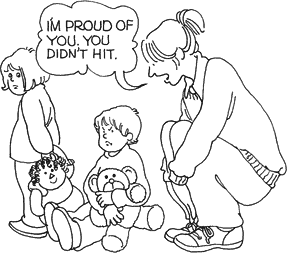
Consequently, if a
parent physically disciplines their children then so too will the children grow
to hit their children when they misbehave. It follows then, that should the
parent hit their partner in the presence of the child, then the child learns
frustration is relieved and arguments are settled through physical force. In
short, according to Jon Piper,
“the sins of the
fathers are punished in the children through
becoming the sins of the children,” which is to say,
through observation and experience children learn what they live.
 Fortunately, through a combination of increased
awareness and psycho-education in the areas of parenting, anger management,
stress management and domestic violence programs it is more than possible to stop
the multi-generational cycle of child abuse. However, the first step is
increasing awareness. For purposes of clarity, please note that in the state of
California the only legal form of physical punishment a parent may use to
correct a transgression is for the parent to spank their child one time with an
open hand upon the child’s posterior. In addition, California further defines
child abuse as any form of physical contact that leaves a mark including
spanking should the spanking leave any marks upon the child’s posterior. If
you, or someone you love, is a victim of child abuse as stated above, intimate
partner violence, or other form of emotional or mental abuse including neglect
help is available 24-7 by calling 211, 1-800-540-4000, or 911. Remember, only
through awareness and advocacy will change occur. Being a child doesn’t have to
hurt!
Fortunately, through a combination of increased
awareness and psycho-education in the areas of parenting, anger management,
stress management and domestic violence programs it is more than possible to stop
the multi-generational cycle of child abuse. However, the first step is
increasing awareness. For purposes of clarity, please note that in the state of
California the only legal form of physical punishment a parent may use to
correct a transgression is for the parent to spank their child one time with an
open hand upon the child’s posterior. In addition, California further defines
child abuse as any form of physical contact that leaves a mark including
spanking should the spanking leave any marks upon the child’s posterior. If
you, or someone you love, is a victim of child abuse as stated above, intimate
partner violence, or other form of emotional or mental abuse including neglect
help is available 24-7 by calling 211, 1-800-540-4000, or 911. Remember, only
through awareness and advocacy will change occur. Being a child doesn’t have to
hurt!
For more information or resources about parenting, anger
management, or domestic violence batterers’ information programs please visit www.nvamc.com. For information about child
abuse resources or support please visit www.dcfs.lacounty.gov .
References:


