
Showing posts with label children. Show all posts
Showing posts with label children. Show all posts
Saturday, September 13, 2014


Sunday, February 9, 2014
Lighting The Way For Others

Wednesday, August 28, 2013
Why Parents Hit Their Children: Stopping The Cycle of Child Abuse
“The sins of the father shall be visited upon the
son” a very powerful and well known biblical
 reference, from the book of Ezekiel,
regarding the raising of one’s family to be righteous. In fact, when we
consider the implications involved in parenting and raising a family, no truer
words have ever been spoken, but not for the reasons one might think. Biblically,
the inference of sinfulness is generally interpreted as impiety, and is avoided
via the father teaching a familial pattern of pious worship.
reference, from the book of Ezekiel,
regarding the raising of one’s family to be righteous. In fact, when we
consider the implications involved in parenting and raising a family, no truer
words have ever been spoken, but not for the reasons one might think. Biblically,
the inference of sinfulness is generally interpreted as impiety, and is avoided
via the father teaching a familial pattern of pious worship.
So how does this infamous quote from scripture apply to the modern family and why is it relevant? This profound and insightful verse is speaking to the multi-generational system of learned behavior that exists within a family. The question then becomes, how do people learn? Cultural Anthropology suggests the most powerful form of learning is observational. Therefore, we learn what we live, which is to say that which we see every day determines how we behave with one another other.

 Fortunately, through a combination of increased
awareness and psycho-education in the areas of parenting, anger management,
stress management and domestic violence programs it is more than possible to stop
the multi-generational cycle of child abuse. However, the first step is
increasing awareness. For purposes of clarity, please note that in the state of
California the only legal form of physical punishment a parent may use to
correct a transgression is for the parent to spank their child one time with an
open hand upon the child’s posterior. In addition, California further defines
child abuse as any form of physical contact that leaves a mark including
spanking should the spanking leave any marks upon the child’s posterior. If
you, or someone you love, is a victim of child abuse as stated above, intimate
partner violence, or other form of emotional or mental abuse including neglect
help is available 24-7 by calling 211, 1-800-540-4000, or 911. Remember, only
through awareness and advocacy will change occur. Being a child doesn’t have to
hurt!
Fortunately, through a combination of increased
awareness and psycho-education in the areas of parenting, anger management,
stress management and domestic violence programs it is more than possible to stop
the multi-generational cycle of child abuse. However, the first step is
increasing awareness. For purposes of clarity, please note that in the state of
California the only legal form of physical punishment a parent may use to
correct a transgression is for the parent to spank their child one time with an
open hand upon the child’s posterior. In addition, California further defines
child abuse as any form of physical contact that leaves a mark including
spanking should the spanking leave any marks upon the child’s posterior. If
you, or someone you love, is a victim of child abuse as stated above, intimate
partner violence, or other form of emotional or mental abuse including neglect
help is available 24-7 by calling 211, 1-800-540-4000, or 911. Remember, only
through awareness and advocacy will change occur. Being a child doesn’t have to
hurt!

So how does this infamous quote from scripture apply to the modern family and why is it relevant? This profound and insightful verse is speaking to the multi-generational system of learned behavior that exists within a family. The question then becomes, how do people learn? Cultural Anthropology suggests the most powerful form of learning is observational. Therefore, we learn what we live, which is to say that which we see every day determines how we behave with one another other.
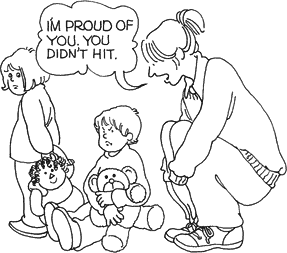
Consequently, if a
parent physically disciplines their children then so too will the children grow
to hit their children when they misbehave. It follows then, that should the
parent hit their partner in the presence of the child, then the child learns
frustration is relieved and arguments are settled through physical force. In
short, according to Jon Piper,
“the sins of the
fathers are punished in the children through
becoming the sins of the children,” which is to say,
through observation and experience children learn what they live.
 Fortunately, through a combination of increased
awareness and psycho-education in the areas of parenting, anger management,
stress management and domestic violence programs it is more than possible to stop
the multi-generational cycle of child abuse. However, the first step is
increasing awareness. For purposes of clarity, please note that in the state of
California the only legal form of physical punishment a parent may use to
correct a transgression is for the parent to spank their child one time with an
open hand upon the child’s posterior. In addition, California further defines
child abuse as any form of physical contact that leaves a mark including
spanking should the spanking leave any marks upon the child’s posterior. If
you, or someone you love, is a victim of child abuse as stated above, intimate
partner violence, or other form of emotional or mental abuse including neglect
help is available 24-7 by calling 211, 1-800-540-4000, or 911. Remember, only
through awareness and advocacy will change occur. Being a child doesn’t have to
hurt!
Fortunately, through a combination of increased
awareness and psycho-education in the areas of parenting, anger management,
stress management and domestic violence programs it is more than possible to stop
the multi-generational cycle of child abuse. However, the first step is
increasing awareness. For purposes of clarity, please note that in the state of
California the only legal form of physical punishment a parent may use to
correct a transgression is for the parent to spank their child one time with an
open hand upon the child’s posterior. In addition, California further defines
child abuse as any form of physical contact that leaves a mark including
spanking should the spanking leave any marks upon the child’s posterior. If
you, or someone you love, is a victim of child abuse as stated above, intimate
partner violence, or other form of emotional or mental abuse including neglect
help is available 24-7 by calling 211, 1-800-540-4000, or 911. Remember, only
through awareness and advocacy will change occur. Being a child doesn’t have to
hurt!
For more information or resources about parenting, anger
management, or domestic violence batterers’ information programs please visit www.nvamc.com. For information about child
abuse resources or support please visit www.dcfs.lacounty.gov .
References:
Sunday, August 4, 2013
Dumping My Bucket of Emotions Without An Angry Outburst!

For many people anger and
disruptive behavior are the result of internalized tension and resentment. In
short, anger represents mental and emotional fill points or bucket of emotion,
that have hit there limit and literally burst. So what is an emotional “fill
point” and how does it affect us? An emotional “fill point” is an imaginary
line used to represent how much stress and anger a person can accumulate before
these negative emotions start to “spill” out in an angry outburst.
Some people have a low fill
line, while others have a high one. Children, on the other hand, tend to have much lower fill lines than
adults, and as such care must be taken when interacting and setting and example
for them. When a child reaches their fill line, they tend to let all their
negative emotions spill out onto others in un- healthy ways. Disruptive
behavior, acting out, anger, irritability, and bullying are the most common
unhealthy ways that a child uses to try and relieve stress by playing out
emotions that they may not be able to verbally express. This is not only
devastating for the child, but also for the unintended victim of the angry lashing
out, be it family, a friend, classmates etc. The most important thing to remember
is that a child, unlike and adult, does not know their fill line; and as such, is unable to actively choose to reduce their
stress and negative emotions before they spill over onto others.

When a child’s
emotional bucket is full, it is up to the caregivers in their lives to help
them learn and begin to use healthy appropriate alternatives to angry out
bursts or they disruptive behaviors. Some effective tools to help children cope
with tension and stress dump are engaging activities including sports, Boys
& Girls Club, summer camp, etc, redirection such as color grounding (have
them choose a color in a room, then prompt them to point out how many places
they see the color), creating a coping box filled with manipulatives, guided
activities, music, slow deep breathing, taking space, etc. Adults, on the other
hand, are able to dump their emotional buckets and make healthy choices to
reduce their tension and anger without prompting; however, the same principles apply.
Appropriate ways for adults to reduce their emotional fill lines include going
to the gym, enrolling in Yoga, slow deep breathing, talking with a friend,
guided imagery, etc.
Whether a child or an adult,
healthy coping may take some practice, but recognizing and appropriately
relieving the anger, stress, and tension built up in an emotional bucket will
ultimately lead to a happier, calmer life.
For more information about healthy alternatives to managing anger, please visit www.nvamc.com, or call 1-888-992-6479 for a free consultation.
Sunday, July 28, 2013
Anger, Disruptive Behavior,Bullying: Stopping Youth Violence

Turn on the television, log on to the
internet, drive by a news stand, and the gut wrenching headlines are
everywhere. Today’s youth are killing one another in horrific acts of anger
based violence. The good news is that children aren't born violent. How a
person responds to frustration and anger are both learned behaviors. The
question is where and how do people learn to respond in the violent and
disruptive patterns plastered all over the media?
The causes of violence/bullying by
youth are many and varied and range from impulse control deficits to
domestic violence exposure.

Attention seeking – Angry, Violent,
or acting out behavior may be the result of wanting others to pay attention to
feelings that the child is unable to verbally express. Remember, negative
attention is better than no attention.
Electronic Media – Children
exposed to everyday violence through movies, television, video games, the
Internet, etc. are often so exposed to violence and disruptive behavior that
they believe it is normal and how people behave when frustrated or upset and as
such engage in violent angry behavior easily and without reservation.
Environmental Influences – Children are
influenced by the people they associate with even when the behavior they see is
known to be wrong; Therefore, they learn and accept the violent behavior they
see from their friends and family as normal then reproduce these behaviors at
school and in the community.
Guns & Knives – The easy
access to weapons of all kinds increases the likelihood of disturbed children
shooting each other in anger.
Home Environment – Children
learn what they live. If the parents in the child’s home are violent and abusive
to each other and the children, then this is how the children learn to interact
in the world.
Lack of Appropriate Role Models – Without
positive and appropriate role models, children don’t learn to resolve conflict
peacefully.

Learning Differences – Children with
learning challenges, whether health related or inherited, is often linked with
frustration and lashing out. If your child or a child in your life is struggling
at school, talk with the teachers and get help. Special education programs are
available to help remove barriers to learning, which reduces the chances of
frustrated kids lashing out at school.
Mental Illness – The effect of
depression, anxiety, stress, homelessness, instability caused by neglect,
substance abuse, etc can all cause youth to act out in frustration and anger.
For further information about
appropriate interventions to assist children and families with learning to
control impulses combined with developing appropriate responses to anger and
frustration, please visit our website at www.nvamc.com,
or call us today for a free consultation at 1-888-992-6479.
Sunday, July 14, 2013
Labeling Your Child’s Disruptive Behavior: Helping or Hurting?
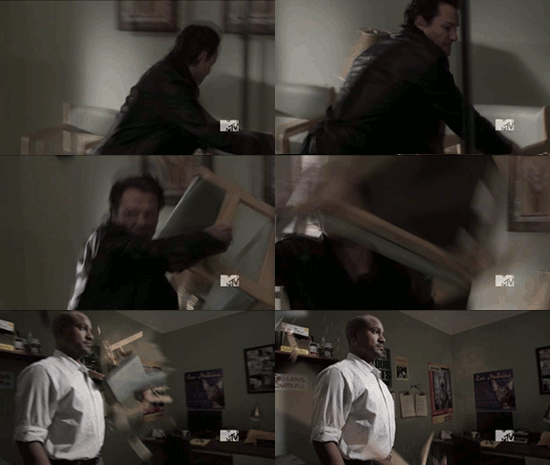 Raising children is never easy at the best of
times. Many things can affect a child’s behavior, and as such our children are
often the emotional barometer of the family. Therefore, it is important to note
that when the level of stress increases in the home so too will our children’s disruptive
behaviors. Stress in a child’s life can come from many sources, including the
addition of another child, parental job loss, a death in the family, divorce,
family relocation, being detained by Child Protective Services, learning
differences, language barriers, developmental delays, family dysfunction, exposure
to domestic violence, substance abuse, etc. Recognizing that our children demonstrate
their feelings through their behavior is a key factor in changing the way we
respond to disruptive behavior.
Raising children is never easy at the best of
times. Many things can affect a child’s behavior, and as such our children are
often the emotional barometer of the family. Therefore, it is important to note
that when the level of stress increases in the home so too will our children’s disruptive
behaviors. Stress in a child’s life can come from many sources, including the
addition of another child, parental job loss, a death in the family, divorce,
family relocation, being detained by Child Protective Services, learning
differences, language barriers, developmental delays, family dysfunction, exposure
to domestic violence, substance abuse, etc. Recognizing that our children demonstrate
their feelings through their behavior is a key factor in changing the way we
respond to disruptive behavior.  Often, our children may appear irritable, angry,
and defiant, as a maladaptive defense against feeling out of control when
stress increases in their lives. For Caregivers, this can be a very difficult
time to parent a child, and understanding that labeling a child demonstrating
anger or disruptive behavior as “bad” or as their mental health diagnosis, if
they have one, is emotionally painful and only compounds the problem. Children
are never bad! Behavior, on the other hand, is a choice and helping a child to
make good choices is the goal, and will make all the difference in modifying
disruptive behavior.
Often, our children may appear irritable, angry,
and defiant, as a maladaptive defense against feeling out of control when
stress increases in their lives. For Caregivers, this can be a very difficult
time to parent a child, and understanding that labeling a child demonstrating
anger or disruptive behavior as “bad” or as their mental health diagnosis, if
they have one, is emotionally painful and only compounds the problem. Children
are never bad! Behavior, on the other hand, is a choice and helping a child to
make good choices is the goal, and will make all the difference in modifying
disruptive behavior.
According to Kelly Sanders, MFT, “When children
get angry and have tantrums, and it happens over and over, it
can be very frustrating for parents to deal with. When the child understands
the consequence of their behavior, but continues to get angry and throw
tantrums, parents may not be sure of what else to do. Parents slip. Teachers
slip. The slip is telling the child that they are “bad” even though the
behavior that they are doing may be more the focus of “bad.” I do not think
that parents or even teachers slip on purpose and telling the kid that he is
“bad,” but we are human and make mistakes, and it happens. Repeating this slip
impacts the child’s self-esteem. Over time, these children may see themselves
as “bad” because they keep repeating the “bad” behavior, receiving the
consequence, and having parents become frustrated, and a negative self-image
begins to form. I know that is not what parents want for their kids. They want
them to have a good sense of self and know how to make appropriate choices by
recognizing what is “bad” behavior and what is “good” behavior.”
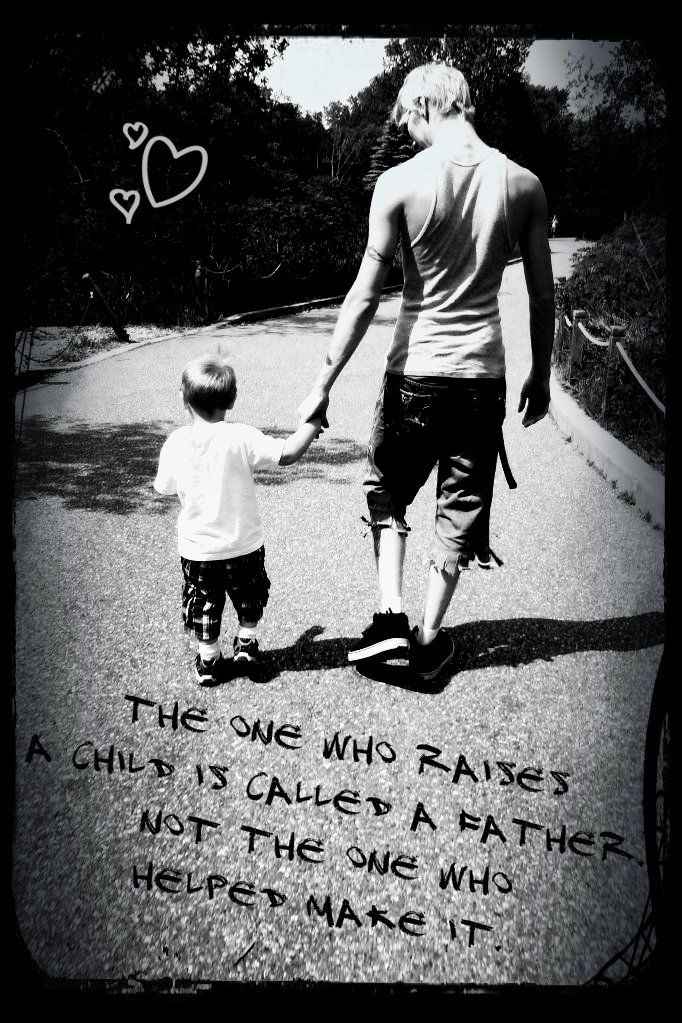
The following excerpt is from an article in the “The Parent Support Line”, by Carole
Banks, MSW, Parental Support Line Advisor, who suggests using the following positive
parenting intervention techniques to re-shape and modify anger outbursts,
tantrums, or other disruptive behaviors children demonstrate when struggling
with increased levels of stress:
“Start where your child is and coach
them forward.”
James Lehman says: “Start where your
child is and coach them forward.” In other words, build on your child’s
strengths and keep your expectations reasonable. We also recommend that you not
try to tackle everything at once, but pick one or two behaviors you want to
change and then move on from there. Remember, your overall goal is to see your
child make improvements—it’s not simply to have your child do what you tell
them to do.
If you feel completely overwhelmed
by your child’s behavior problems, here are 8 tips to help you focus on
changing your child's behavior, step by step.
1. Try to Have Reasonable Goals
I think that many times instead of
trying to make gradual changes, parents expect that all the inappropriate
behavior will stop immediately. The truth is, you might see certain behaviors
stop right away, but it doesn't necessarily mean your child will never act out
again. It’s not going to be instantaneous, and it will take just as much
practice on your part as it does on your child’s part. Change takes time. It’s
not just you who needs time practicing new techniques. Your child also needs to
practice so he can learn by repetition. The reason you want to ask for
reasonable change is because your child cannot make major changes all at once.
2. Coaching Your Child Forward: Know
What His Strengths Are
It’s important to have a good idea
of what your child is capable of doing. Here’s an example: Some kids have an
issue like ADD or ADHD. It’s important to get a really good understanding of
what ADHD looks like in your child. Is it hard for him to focus and stay
organized? Maybe he daydreams when he’s supposed to be working. Every child is
different, and it’s important for you to modify your expectations accordingly.
It’s also important for your child to know what his strengths and weaknesses
are so he can recognize when he’s getting off track and learn how to get back
on. After determining what your child’s strengths and weaknesses are,
understand that he will make improvements from that starting point.
I've seen kids who are defiant or op-positional completely throw in the towel because they’re not capable of doing
what you’re asking, particularly in relation to school work. That’s why it’s
extremely important to find out what your child’s abilities are and begin right
there. That’s one of the most important steps in making sure your expectations
are reasonable.
3. Keep in Mind That Your Child is
Working Toward a Goal
Accept that your child is working
toward a goal. In other words, your child is probably not going to be able to
stop his inappropriate behavior on a dime. If your teen is in the habit of
getting his way by intimidating others in the family with his angry outbursts,
understand that this behavior is not going to go away immediately. Work with
him on making small steps toward good behavior. You might say, “You need to
give me your cell phone for the next two hours until you can behave and talk
appropriately.” The key is that during that time, your child is practicing this
new skill. You’re not saying, “That’s it—you’ve lost your phone all day.” Many
kids struggle with punishments that last too long and end up giving up halfway
through. Instead, you want to have short-term goals throughout the day. Work
toward short-term accomplishments and successes all day long.
4. Pick One Behavior to Work on at a
Time
When I ask parents what they’d like
to start working on with their child, many say general things like, “I just
want my kid to listen to me,” or “I want my teen to do what I ask him to do
when I ask him.” I think it’s very important to pick a specific behavior to
start with and a time of day when it should be accomplished. When you’re just
beginning to use the techniques in the Total Transformation Program, it’s
important to put some structure in your child’s schedule or else you’re too
likely to get into a power struggle with him each time you ask him to stop what
he’s doing and do what you want. Choose a concrete behavior, such as doing
homework daily, or being home at curfew, instead of working on your child’s attitude.
You might feel concerned because you’re letting other behaviors slide when you
focus on just one, but realize that your child is actually learning skills when
he changes one behavior at a time—skills that he will be able to use in all
situations going forward. Primarily, he is learning how to do what he doesn't feel like doing, and that there will be a consequence if he behaves
inappropriately. Make no mistake, a lot is happening when you choose one
behavior at a time and work solely on it.
5. Start with Physical Behavior
Many parents ask, “Where do I
start?” I always recommend that you begin with physical behavior first. It
could be a safety issue, like your child sneaking out of the house at night.
Many parents will say that back talk is the biggest thing they’re dealing with.
It’s really hard for them to tolerate, and that’s natural. But if your child is
not coming home at night, I suggest putting backtalk aside for a bit and
focusing on making sure he’s safe and complying with house rules regarding
curfew.
Physical behavior can also apply to
kids who act out and are destructive or abusive at home. If your child is
punching holes in the walls or intimidating his siblings physically, you want
to start there. We recommend that you adopt James’ philosophy of, “There’s no
excuse for abuse” in your family. Let your kids know there will be stern
consequences for their actions and follow through on them.
A lot of parents will avoid tackling
these big issues because it’s easier to pick something small than it is to
address the big scary things. But if it’s a health or safety concern I don’t
think you have any choice—that should always come first.
6. Can’t Decide Which Behavior to
Tackle First? Get Some Help
There are some instances where you
may be forced to deal with two behaviors at the same time. Let’s say your child
talks back to you while you’re trying to help him complete his homework
assignment, and you’re not sure which behavior to address first. This is where
the Total Transformation Parental Support Line can be really helpful. We can
help you determine, based on your child and what his overall behavior is like,
what the best issue is to address first. We can tell you what technique to
really focus on and which ones to set aside for later—and we’ll help you come
up with a practical strategy.
7. If Your Child Doesn't Seem to be
Making Enough Progress…
A common stumbling block for parents
is when they feel as if their child isn’t making enough progress. But remember,
the goal is that your child improves—not that they will listen to you 100% of
the time. It’s very different.
Sometimes you can change that by
changing your parenting techniques and the house rules. Power struggles between
you and your child will usually cause him to dig in and not cooperate. Putting
more structure into place is sometimes necessary. You might say, “You have to
do your chores Saturday morning if you want to go out Saturday night. Get
started at 10:00 a.m.”
At other times, your child might be
having real difficulty making improvements. James Lehman says we have to
“parent the child we have and not the child we wish we had.” He reminds us that
our kids are unique individuals. This brings us back to the importance of
determining your child’s capabilities—again, be sure that what you’re asking of
your child is reasonable.
8. Don’t Take It Personally
Many parents also get trapped in
wanting their kids to feel a certain way. They want their kids to care about
cleaning their room or to care about the effect doing homework will have on
their future. The truth is, it’s not your child’s fault; he’s really not wired to feel that way yet. The important thing is not that your child cares, it’s
that he learns how to do things even if he doesn't feel like doing them. This
is a huge life skill.
When you’re working to have your
child’s behavior change, try to pay attention to what it looks like rather than
what your child is saying. James says to ask yourself, “What would I see if I
were watching this on television with the sound turned down? What would my
child’s behavior look like right now?” I think this is a really good way to
visualize what behavior is when you’re having a hard time separating it from
what your child says or feels. Just ask yourself, “What is my child doing?”
Let’s say the sound is turned down
and you see your teenager fighting with you, then he’s stomping off to clean
his room. He may be sullen and have a bad attitude, but he’s also doing what
you asked. Work on the behavior first, and the attitude will come. James says,
“Don’t feel your way to better behavior; behave your way to better feelings.”
And that’s exactly what you want your child to do.
Sometimes in parenting, it really is
“two steps forward, one step back.” But remember, even if that’s the case, you
are still moving forward. Yes, your child will challenge you. He’ll come back
and test you to see if things have really changed; he’ll see if he can get you
to go back to the way you used to be, particularly if he was calling all the
shots. But stand your ground and eventually his behavior will change. One way
to stay encouraged is to remember where your child started and compare it to
the progress he’s made. It’s also important to encourage your child when this
happens. Keep saying things like, “I know you can make improvements because you
have already done it. Keep at this.
For more information regarding the connection between negative labels and children struggling with anger or disruptive behaviors, please visit our website at www.nvamc.com or call us at 1-888-992-6479. Change is never easy, and doesn't happen overnight, but it begins with you. If you are reading this article, you are taking the first step!
Sunday, November 18, 2012
How to Survive The Holidays Anger Free
The Holidays can be challenging for many people, most especially during these difficult economic times. Whether finances or family are giving you the Holiday Blues, following the road map below will definitly help you to successfully negotiate the emotional tidal wave associated with the season without loosing control, exploding in anger, or over indulging.
The key surviving the Holidays without explosive anger is resiliency: Having resilency means developing a set of tools we can use to cope with the various emotional challenges and triggers the Holidays may bring. Resiliency is a learned behavior that anyone may learn and incorporate at any point in their life.
Defining Resilience:
The key surviving the Holidays without explosive anger is resiliency: Having resilency means developing a set of tools we can use to cope with the various emotional challenges and triggers the Holidays may bring. Resiliency is a learned behavior that anyone may learn and incorporate at any point in their life.
Defining Resilience:
The word "resiliencies" is used to describe clusters of stengths that are mobilized in the
struggle with hardship. The vocabulary of strengths includes seven resiliencies which are as
follows:
Insight -
asking tough questions and giving honest answers.
Independence -
life.
distancing emotionally and physically from the sources of trouble in one's
Relationships -
making fulfilling connections to other people. -
Initiative -
taking charge of problems.
Creativity -
using imagination and expressing oneself in art forms.
Humor -
finding the comic in the tragic.
Morality -
acting on the basis of an informed conscience.
Diagramming the Seven Resiliencies:
The Wolins have represented the resiliencies pictorially on a diagram they call the
resiliency mandala. A symbolic circle that stands for peace and order in the self, the mandala
peace and order in the self, the mandala
was identified by Carl Jung as a universal symbol.
For more information about coping with anger, or a free consultation, please call 1-888-992-6479 or visit our website at www.nvamc.com today.
Happy Holidays!
North Valley Anger Management Consultants
Wednesday, June 20, 2012
The Price of Domestic Violence
 Domestic violence (DV) is more than anger. It is more than abuse. It is not about gaining pleasure from inflicting pain. What it is about is the power and control of one person over another brought about through a combination of intimidation, physical, mental, and emotional cruelty. What domestic violence is is a living nightmare for the victims trapped within it's clutches. It is in every city, on every block. It is unbias and nondiscriminatory. It effects rich and poor alike and has no regard for social or political status, and its effects are long term and hereditary.
Witnessing domestic violence is in and of itself a form of child abuse and neglect. Unfortunately, the trickle down effect of DV does not end there. Domestic violence is often discussed clinically, in terms referring to the physical, psychological, behavioral, and societal cost,yet it is the human cost that needs to be profiled. The physical effect of domestic violence alone, such as damage to a child's growing brain, can cause developmental and learning impairment including cognitive delays and behavioral difficulties. However, the physical effects of exposure to abuse is only the tip of the iceberg.
 As the children from a home with domestic violence grow up, they are predisposed to become abusers themselves. The recurring cycle of violence often begins on the school yard, with the child bullying other children, and ultimately ends with the child becoming an adult who perpetrates domestic violence themselves.
According to the United States goverment, an estimated 905,000 children were victims of exposure to domestic violence, a form of child abuse, both physical and emotinal, and neglect in 2006 (U.S. Department of Health and Human Services, 2008). While physical injuries may or may not be immediately visible, abuse and neglect not only can but will have consequences for the children and families that experience this abuse that will last the course of the victims lifetime, and often for generations to come.
 For these families, living in fear and pain is all they know. The emotional and physical cost of domestic violence to children and families is unconscionable. Stopping the cycle of violence is the only way to end the multi-generational pattern of abuse being passed down from parent to child ad infinium amen.
IF YOU ARE A VICTIM OF DOMESTIC VIOLENCE PLEASE CALL YOUR LOCAL SHELTER, YMCA, OR LAW ENFORCEMENT AGENCY IMMEDIATELY. THESE AGENCIES MAY BE REACHED BY DIALING 211, 411, OR 911.
If you are a batterer/perpetrator and have been court ordered to seek help in stopping the abuse, or are self referred, please call 818-606-7531 for more information, or visit our website at www.nvamc.com.
For more information about the effect of abuse on children, stopping the cycle of domestic violence, resources to help a victim recovering from domestic violence abuse, please visit the following websites:
http://www.cpedv.org/
cadv.org/children.html
http://www.youtube.com/watch?v=xYWxfxMOUO4
Sunday, March 11, 2012
Anger in Your Relationship: When to Get Help

Anger, left uncontrolled, can be one of the most dangerous and destructive components in a relationship. Often, both hetero and same sex couples struggling with anger problems are unaware of why their relationship continues to deteriorate. Although, a couple struggling with anger may be committed to one another, knowing when it is time to reach out for help can play an important part in beginning to heal the relationship. If your relationship is falling apart, due to anger management issues, the following list of symptoms and behaviors may help you identify when to reach out for help:
1. Feeling controlled or micromanaged by your partner
2. Feeling afraid of your partner at anytime (get help immediately)
3. Unable to express wants, needs, or desires out of fear of partner rejection
4. Fear of physical or verbal attack (get help immediately)
5. Unable to communicate without partner getting angry
6. Children being effected by arguing in the home (can't focus in school)
7. Children feeling afraid of parents
8. Children feeling they have to protect either parent

A loved ones anger may be a symptom of a deeper mental health health concern requiring professional assistance, or it maybe a communication concern that anger management classes combined with relational therapy may be able to address. However, the first and most important step is knowing when to reach out and ask for help. If you, or someone you love, are dealing with any these symptoms/behaviors in a relationship, please seek help immediately. Moreover, if you are in a relationship and are feeling afraid of your partner, or your children are afraid of a parent, or fear for a parent, seek help immediately by calling the National Domestic Violence Hotline at 1-800-799-7233. No one has to live with anger between themselves and a loved one, and no one should ever live in fear. Help is available 24 hours a day. For more information, or a for free consultation, please call 1-888-992-6479 or visit our website at http://www.nvamc.com/.
Subscribe to:
Posts (Atom)