
Showing posts with label family. Show all posts
Showing posts with label family. Show all posts
Tuesday, July 7, 2015
When Gambling Becomes A Problem
How do you know if frequent weekends in Vegas have become a gambling addiction? The signs of a gambling problem are often the same as the signs of other addictions. Common signs of a gambling addiction include:
• Feeling the need to be secretive about your gambling
• Having trouble controlling your gambling habits
• Gambling when you cannot afford to do so
• Friends and family often expressing concern with your gambling
Of course, as with any other addiction, the hallmark sign of a gambling problem is that you feel you cannot stop. Gambling is a diverse activity, so it is not always obvious when someone is addicted to gambling. Contrary to popular belief, the act of gambling is not restricted to slot machines, cards and casinos. Purchasing a lottery ticket, entering a raffle or making a bet with a friend are also forms of gambling. Gambling addiction is associated with many additional challenges, in both the short- and long-term, beyond that of gambling. Consequently, a gambling addiction frequently results in other addictions that serve as coping mechanisms for people who are stressed out by the activity. Many gamblers turn to drugs, alcohol and other activities to alleviate the anxiety brought on by the gambling lifestyle. Even if a gambler never experiences financial ruin as a result of the lifestyle, they may struggle with drug and alcohol addiction for the rest of their life after self-medicating to deal with the stress.  Gambling addiction can occur when a person feels that they are in financial ruin and can only solve their problems by gambling what little they have in an attempt to win a large sum of money. Unfortunately, this almost always leads to a cycle in which the gambler feels they must win back their losses.
Because gambling addiction is often associated with depression and anger, quitting gambling is no easy feat, but it can be done with the help of a solid support group and treatment program. It can be difficult to get started on the path to recovery without the assistance of professionals who have helped people through the process before. Supportive friends and family are vital to a full recovery, but they might not know how best to help you.
If any of this sounds familiar, you, or someone you love, may be struggling with a gambling addiction. In California, help is available for the gambler, and the gambler’s family, with no zero out of pocket expense. For further information, please call 1-800-gambler, or visit the following website www.problemgambling.ca.gov
Gambling addiction can occur when a person feels that they are in financial ruin and can only solve their problems by gambling what little they have in an attempt to win a large sum of money. Unfortunately, this almost always leads to a cycle in which the gambler feels they must win back their losses.
Because gambling addiction is often associated with depression and anger, quitting gambling is no easy feat, but it can be done with the help of a solid support group and treatment program. It can be difficult to get started on the path to recovery without the assistance of professionals who have helped people through the process before. Supportive friends and family are vital to a full recovery, but they might not know how best to help you.
If any of this sounds familiar, you, or someone you love, may be struggling with a gambling addiction. In California, help is available for the gambler, and the gambler’s family, with no zero out of pocket expense. For further information, please call 1-800-gambler, or visit the following website www.problemgambling.ca.gov


Thursday, August 7, 2014
Cut Your Stress Today: Anger & Stress Management Tips For Busy People

Sunday, March 30, 2014
Grand Opening & Ribbon Cutting!!!
.JPG)
Sunday, December 15, 2013
The Twelve Angry Days of Christmas

On the first day of Christmas: Reduce stress by managing your time carefully and not over-scheduling yourself. Take time for yourself!
On the second day of Christmas: Adjust your expectations of family members. No, Uncle Bill hasn't changed since last year. Tell yourself that you only have to see her once a year- you can cope with it.
On the third day of Christmas: Limit the amount of time you spend with stressful family members. Remember the "spirit" of the season can be shared just as well with brief quality time.
On the fourth day of Christmas: Work on increasing your forgiveness skills. Let old resentments go. Holding grudges hurts you more than your relatives.
On the fifth day of Christmas: Develop better empathy skills. Try to see the world from the viewpoint of irritating family members and you may be shocked at how your anger dissipates.
On the sixth day of Christmas: Limit the amount of time you spend shopping and going to parties. Too many Holiday rounds only adds necessary expense and stress. Christmas isn't about buying gifts and going to parties. Remember the "spirit" of the season is about sharing love and quality time with family and friends.
On the seventh day of Christmas: Watch carefully the amount of alcohol you consume. Many anger management students confess that excessive drinking definitely contributed to family conflict and aggression.
On the eighth day of Christmas: Celebrating the Holidays doesn't have to be expensive. You can keep Christmas alive and well without going broke. Reconnect with the meaning of Christmas through religious or cultural practices.
On the ninth day of Christmas: When you feel frustrated and your temper starts to rise, try counting to 10 slowly. Time out isn't just for kids! Before saying things you might regret, take a few moments to breathe deeply and count to 10.
On the tenth day of Christmas: When Holiday spirits are flowing and your in the heat of the moment, it's easy to say something you'll later regret. Take a few moments to collect your thoughts before saying anything by counting to 20 backwards.
On the eleventh day of Christmas: Forgive and forget! Don't allow anger and other negative feelings to get in the way of positive feelings that come with the season. You can do it!
On the twelfth day of Christmas: Relax, breath and enjoy your family, friends and celebrate the Holiday! If your temper flares, use your relaxation skills. Practice deep-breathing exercises, imagine a relaxing scene, or repeat a calming word or phrase, such as, "Tomorrow is Christmas." You can do it!
For more tips on how to deal with angry feelings, Holiday stress, or the angry behavior of others, call us at 1-888-992-6479 or visit our website at www.nvamc.com
Happy Holidays from North Valley Anger Management Consultants!
Anger Management Classes: Sunday Group
Monday, December 9, 2013
Is It Normal To Feel Angry?
Is anger normal? Absolutely! Everyone feels angry. It’s what we do with the feeling of anger that matters. Per George Anderson, LCSW, anger is a normal human emotion. In fact, anger is one of the first indications that a person may feel emotionally injured. It is important to note that anger is a secondary emotion that exists to protect people from feeling the more vulnerable emotions such as hurt, loss, grief, fear, offended, attacked, frightened, lonely or sad. This is not an uncommon response, often initiated by our psyche during times of stress in response to the more sensitive feelings.

However, anger also has very negative connotations, and when out of control is often associated with unhealthy and abusive aspects of the human condition. Anger maybe considered a problem when it is too intense, occurs too frequently, is harmful to self or others, lasts too long or leads to aggression. Unfortunately, as the economy continues to struggle and the cost of living remains sky high; incidents of unhealthy anger and aggression have increased ten fold worldwide. This increase is visible across all sectors of our society including government, politics, professional sports, business, education, and medicine.
If you or someone you love is experiencing unhealthy levels of anger or aggression, their emotional intelligence may no longer be effectively managed at the individual or family level, and may require voluntary and mandated training in stress management, anger management, communication and impulse control.
For more information about managing stressful emotions, please visit our website at www.nvamc.com, or call us at 1-888-992-6479.
Saturday, November 30, 2013
Family Stress & Holiday Cheer: A Survival Guide

As pretty a picture as the media would try to sell us, we all know the truth. The Holidays are full of family stress, anger, conflict, and pressure. In fact, some of the following stress filled messages may be running through your mind right now. What will we make for dinner? Who is coming over? What is the budget looking like for presents this year? How do I stop myself from getting angry at the in-laws? Where will my family stay? Is there enough space in our house? Will the kids actually let me sleep today? Do I really want to have to talk to my brother, mother in law, cousin, other family members I don't like ?
With all these stresses and pressures a short temper, anger, and cranky snappy responses are bound to arise. All it takes is the smallest thing to set us off during family gatherings, which often leads to poor coping resulting in overeating and excess alcohol consumption. At times, this may seem like the only way to get through the Holiday Season. Admittedly, safely coping with the Christmas Season in a positive and healthy way is not always easy, but it can be done. Often, it is the little things that help the most. The following is a list of helpful tricks to help you cope:
1. Remember to breathe- the Holidays don’t last forever.
2. This too shall pass! Try to keep in mind that even with all the build up, expectations and disappointment that often come with the season, ultimately they are just days, and you can get through them just like you do every other day that has come, or is yet to come.
3. Be aware of your mood and tone of voice, your body language.
4. It's not all about you! Other people are stressed too. Don't take other peoples moods and behaviors personally.
5. Please remember that alcohol only adds to the problem, and can be down right dangerous. Keeping the Holiday cheer in check will help keep the anger and stress in check too.
 It helps when you realize that everyone else is just as stressed as you are. You are not alone; just smile, relax and try to enjoy what you can. Remember, you are the only one who can keep yourself safe, sober, and under control. For information and assistance coping with holiday stress, please visit our website at www.nvamc.com or call us toll free at 1-888-992-6479 today.
Happy Holidays from North Valley Anger Management Consultants
Tuesday, November 19, 2013
Thanksgiving Happiness and the Holiday Blues

The Thanksgiving Holiday season kicks off a five week period
of time that brings back memories of happiness and accomplishment for millions
of people. This special day is filled with family traditions, memories, and
expectations that some people find difficult, or impossible, to manage.
Frequently, our anticipation and excitement turns into feelings of depression,
commonly called the holiday blues. Symptoms can include headaches, insomnia,
uneasiness, anxiety, sadness, intestinal problems, and unnecessary conflict
with family and friends. Part of what happens during the holiday season, in
terms of mood changes and anxiety, may occur because of the stressfulness of
holiday events, while other aspects of mood change and anxiety may be rooted in
unresolved grief and loss. Irregardless, the challenge comes from coping with
these feelings in a safe and positive manner. Unfortunately, many people deal
with the uncomfortable and often overwhelming feelings by overdrinking, overeating,
and overspending. It may be important to note that these feelings of sadness
and depression can reach a clinical level during the holiday season. If you, or
someone you love, begin to have thoughts of suicide, homicide, or other high
risk or self injurious behaviors, please seek professional help immediately, or
call the crisis hotline at (714)
NEW-HOPE (714) 639-4673. The hotline is available 24 hours a day, seven (7) days a week. The
demands of the season are many and varied: shopping, cooking, travel,
houseguests, family reunions, office parties and extra financial burdens are
part of the short list as the season unfolds. Our current recessionary economy
may still be affecting us, or someone close to us, which further exacerbates
stress levels leaving many feeling even more depressed. Keeping our lives in
perspective on this special day of sharing and caring, can make a big
difference in how well we are able to cope with the extra stress and
uncomfortable feelings. The following tips are something for people to consider
to help manage the additional stress and anxiety that this special day carries.
Remembering that even though it feels uncomfortable, sometimes family, friends,
and co-workers may lose sight of the feelings of other people during this busy
holiday season. It is not personal! Being considerate and compassionate toward
others is a tough balancing act. The following recipe for Holiday Harmony is
worth your consideration.
C.A.R.E.S. recipe for Happy Holidays:
1. Communication:
Keep it positive with an extra dose of active listening to make people feel
like you really care. People feel more at ease when you are genuinely
interested in a conversation.
2. Anger Management:
Recognize your triggers and walk away from verbal conflicts before they
escalate. It’s ok to “put your temper in the crock pot before you lose your top”.
It’s ok to ask for a time out when your upset, frustrated, or feeling flustered
from negative emotions. It’s ok to cool off and regroup.
3. Relationship Management:
Plan your day and company with positive people. This is a special challenge
when large groups come together. Please consider this time as a few hours of
compromise when that obnoxious family member or person makes their cameo
appearance with other people you care about.
4. Emotional
Intelligence: Please consider other peoples thoughts, feelings and opinions
before taking a stand or making a comment to someone else. Please remember we
have two ears to listen twice as much as we speak. Interrupting a conversation
is considered to be inconsiderate or rude behavior. Please remember your tongue
is the strongest muscle in your body. The words you choose can easily overwhelm
another person in a negative way if your tone, body language or lack of consideration
are not well measured.
5. Stress Management:
Develop an awareness of your negative stressors and consider writing them down
if your memory banks are easily overwhelmed. Remember that “failing to plan is
planning to fail”. Time and financial management are critical especially during
the busy holiday season.
Happy Thanksgiving from all of us at North Valley Anger
Management Consultants! For further information regarding anger management, emotional
intelligence, or domestic violence, please call 1-888-992-6479 or visit our
website at www.nvamc.com. For further
information regarding crisis intervention please call 1-714-NEW HOPE
(714-639-4673) or visit www.suicidehotlines.com
Saturday, April 20, 2013
Anger & Fatigue: A Potential Recipe for Disaster!
 Fatigue is symptom of modern life; all of us feel it, some more than others. However, as common place as it is these days, have you ever found yourself wondering just what is this exhausted feeling all about? The Webster’s dictionary (www.webster.com) defines fatigue as "Extreme tiredness, typically resulting from mental or physical exertion or illness." There are many causes for it, work, family, money etc. In fact, per a recent article in Psychology Today (www.psychologytoday.com) it is during these times of extreme fatigue that we are much more likely to let our emotional mind rule us. Consequently, as a result of fatigue, we become too tired and too run down to really think before we act/speak, or care about the damage our angry behavior might cause in the future.
Ironically, as difficult as it may be, it is during these moments of extreme fatigue that we must be most vigilant about thinking our actions through and controlling our emotions. In short, the anger and resentment underlying our fatigue is not a product of a rationale mind, but is instead a purely emotional response to stress resulting from extreme fatigue. As hard as it is to endure, many of the hardships we face today, such as college and paying a mortgage, will make our future a little easier. Emotional
 control of our anger response during periods of fatigue may be hard to obtain at first, but conscious effort will soon come as naturally as breathing. With time, patience, and awareness we all can be successful in controlling out anger and redirecting it in positive ways even during periods of extreme fatigue. Although taxing and often overwhelming, don't give up the struggle to succeed in these modern times; ultimately, it will be worth it!
Monday, January 14, 2013
Causes & Cures For Anger
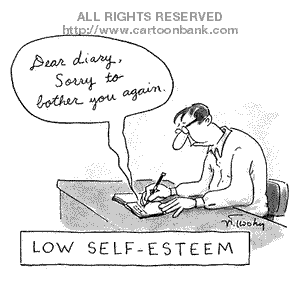 Anger is a secondary emotion that people unconsciously use to protect or deflect a wide variety of uncomfortable feelings away from themselves and possibly onto other people. Many times anger stems from low self-esteem, or other feelings of inadequacy. What then is self-esteem and why is it important? How can we recognize it and what can we do to increase it? While much of a person’s self-esteem is developed throughout their childhood and is rooted in their family of origin, we can always make the conscious effort to alter our behaviors and learn to increase our sense of purpose, accomplishment, and acceptance later in life. This is typically a slow process and it isn’t always easy.
Here are some ways to catch these negative patterns as they happen, and to begin changing them.
•Get sober. Get help through 12-step groups to stop self-destructive behaviors. Addictions make learning harder and can bring down your mood.
•Practice self-care. Make new positive lifestyle choices.•Identify triggers to low self-esteem. Don’t personalize negative or stressful events (e.g., criticism). If you do a self-defeating action usually follows.
•Stop and take notice. Pay attention to the familiarity of the impulse. We tend to overreact in the same way to the same things over and over again.
•Acknowledge reaction. Take note of how you are reacting. Then actively choose to change it rather than just passively noticing it.
• Choose response. Hold in self-defeating impulses and instead act in a positive, self, caring and functional way.
◦Experience feelings. “Feel” feelings in your body and identify your needs. When we do not respect our feelings, we are left to rely on what others want and believe.
 ◦Detachment. End all abuse; say “no” to misrepresentations and assumptions. By maintaining personal boundaries, we discourage abuse by others and assert our separateness.
◦Assertion. Voice what you see, feel, and want by making “I” statements. By expressing our thoughts, feelings, and desires in a direct and honest manner, we show that we are in charge of our lives.
◦Receptivity. End self-absorption; listen to others’ words and meanings to restate them. In this way, we act with awareness of our contribution to events as well as empathize with the needs of others. For more information about coping with anger through increasing self esteem, please visit our website at www.nvamc.com, or call us at 1-888-992-6479. Remember, "we are not responsible for being down, but we are responsible for getting up" (Jessie Jackson).
Tuesday, December 25, 2012
Anger: A Normal Human Emotion
 Per George Anderson, LCSW, anger is a normal human emotion. Consequently, our anger is one of the first indications that we have sustained an emotional injury that causes us to feel, hurt, offended, attacked, frightened or sad. This is not an uncommon response to more vulnerable feelings. In fact, anger even has a positive side to it. Some examples of the positive uses of anger include Martin Luther King and his struggles to end discrimination in America, Nelson Mandela (www.nelsonmandela.org) whose struggle against South Africa mobilized most of the world against his adversaries, and Rosa Parks whose anger was the source of the Montgomery Bus Boycott. Another example of a positive outcome in sighted by anger is that of Mahatma Gandhi, whose anger and resulting passive resistance stance against England occurred in direct response to Britain’s domination of India.
  However, anger also has very negative connotations, and is often associated with unhealthy and abusive aspects of the human condition. Anger maybe considered a problem when it is too intense, occurs too frequently, is harmful to self or others, lasts too long or leads to aggression. Unfortunately, as the economy continues to struggle and the cost of living remains astronomical, there has been an increase in unhealthy anger and aggression worldwide. This increase is visible across all sectors of our society including government, politics, professional sports, business, education, and medicine.
Therefore, emotional intelligence may no longer be effectively managed at the individual or family level, but may require voluntary and mandated training in stress management, anger management, communication and impulse control.
For more information about managing stressful emotions, please visit our website at www.nvamc.com, or call us at 1-888-992-6479.
Saturday, December 8, 2012
Take the Anger Out of Christmas!

In keeping with the holiday spirit of hope and salvation, North Valley Anger Management Consultants, in Mission Hills, CA., thought the following tips maybe useful to help you and your loved ones deal with holiday stress:
1. Watch carefully the amount of alcohol you consume. Many anger management students confess that excessive drinking definitely contributed to family conflict and aggression.
2.Reduce stress by managing your time carefully and not over-scheduling yourself. Take time for yourself.

4. Work on forgiveness skills. Let old resentments go. Holding grudges hurts you more than your relatives.
5. Develop better empathy skills. Try to see the world from the viewpoint of irritating family members and you may be shocked at how your anger dissipates.
6. Limit the amount of time you spend with stressfull family members. Remember the "spirit" of the season can be shared just as well with brief quality time.
7. Celebrating the holidays doesn't have to be expensive. You can keep Christmas alive and well without going broke. Reconnect with the meaning of Christmas through religious or cultural practices.

Happy Holidays from North Valley Anger Management Consultants!
Sunday, November 18, 2012
How to Survive The Holidays Anger Free
The Holidays can be challenging for many people, most especially during these difficult economic times. Whether finances or family are giving you the Holiday Blues, following the road map below will definitly help you to successfully negotiate the emotional tidal wave associated with the season without loosing control, exploding in anger, or over indulging.
The key surviving the Holidays without explosive anger is resiliency: Having resilency means developing a set of tools we can use to cope with the various emotional challenges and triggers the Holidays may bring. Resiliency is a learned behavior that anyone may learn and incorporate at any point in their life.
Defining Resilience:
The key surviving the Holidays without explosive anger is resiliency: Having resilency means developing a set of tools we can use to cope with the various emotional challenges and triggers the Holidays may bring. Resiliency is a learned behavior that anyone may learn and incorporate at any point in their life.
Defining Resilience:
The word "resiliencies" is used to describe clusters of stengths that are mobilized in the
struggle with hardship. The vocabulary of strengths includes seven resiliencies which are as
follows:
Insight -
asking tough questions and giving honest answers.
Independence -
life.
distancing emotionally and physically from the sources of trouble in one's
Relationships -
making fulfilling connections to other people. -
Initiative -
taking charge of problems.
Creativity -
using imagination and expressing oneself in art forms.
Humor -
finding the comic in the tragic.
Morality -
acting on the basis of an informed conscience.
Diagramming the Seven Resiliencies:
The Wolins have represented the resiliencies pictorially on a diagram they call the
resiliency mandala. A symbolic circle that stands for peace and order in the self, the mandala
peace and order in the self, the mandala
was identified by Carl Jung as a universal symbol.
For more information about coping with anger, or a free consultation, please call 1-888-992-6479 or visit our website at www.nvamc.com today.
Happy Holidays!
North Valley Anger Management Consultants
Subscribe to:
Posts (Atom)